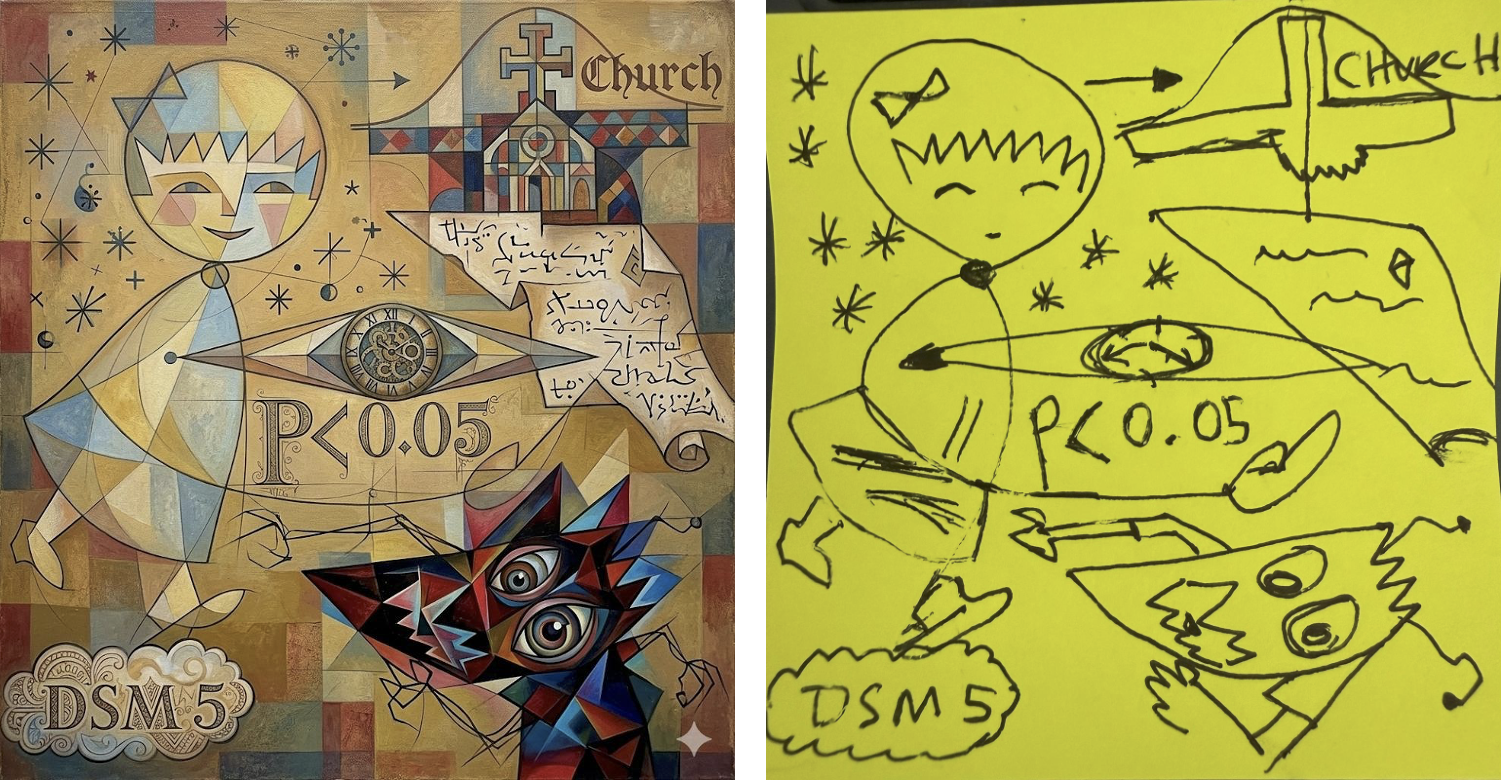
I have always been a doodler. Sticky notes are my preferred canvas. During meetings, while talking with patients, sometimes in the middle of a phone call, I draw small diagrams: arrows, faces, fragments of symbols. It has always been clear to me that the drawings are not meant to be art but rather a way of thinking. Donald Winnicott had the squiggle game, a shared drawing that allowed therapist and child to discover meaning together and my doodles function in a similar way. That is, when words stall, the pen moves and the sticky notes become canvas, a triangle becomes a person, a line becomes a direction. I draw an arrow to suggest a connection that my client had not yet grasped. Over time, the practice became automatic. I doodle to keep attention alive because when the hand moves, the mind follows. The marks are crude ad rudimentary yet full of intention as they manifest ideas: a face, a feather, an eye, a sun, a small figure with a heart are symbols that map a thought that is still forming, that can facilitate our way to an understanding. Until recently the value of these drawings was entirely internal, simply a scaffolding for thinking, alone and together and, once the conversation ended, the sticky note could disappear. Then I tried something new. I took one of the doodles, a chaotic collection of faces, arrows, numbers, and fragments, and uploaded it into an AI image generator. Seconds later the system returned a painting. The shapes were the same but stabilized. The fragments had become a coherent style and color appeared where my pen had left only lines. The crude symbols, the eye, the feather, the triangular figures, were transformed into something that looked deliberate, professionally-looking images, like a piece of modernist illustration that might plausibly hang in a gallery. And that is when the disturbance appeared. While the object looked like the result of skill, the process contained almost none. Historically, craft tied effort to artifact. Richard Sennett, in The Craftsman, describes how objects carry the memory of the labor that produced them. A violin or a painting is not simply an object, but it fundamentally represents compressed practice because it contains the traces of years spent learning how to see and how to move the hand. My doodle contained no such history. It took perhaps thirty seconds. Yet the system expanded that small gesture into something that visually implied training. In psychoanalysis there is a different model of transformation. Freud described therapy as “working through”: the repeated encounter with difficulty that gradually reorganizes the person experiencing it. Wilfred Bion later described this as the process by which raw emotional material becomes thought. In both cases, effort is not incidental. The repetition is what produces change. That repetition establishes our psychotherapeutic practice. Intentional effort, repetition, and practice create meaning. Generative AI interrupts that loop. The difficult part of the process (the execution, the refinement, the stabilization of form) is handled by the system while the human contribution shifts toward something smaller but still decisive: placing the signal. The doodle becomes a seed and from that seed the machine grows the object. The question that follows is simple but uncomfortable: if the artifact appears sophisticated but required almost no effort, what exactly did the human create? Perhaps not the painting itself. Perhaps only the direction from which the painting could emerge. Perhaps the human in the loop.